Showing posts with label 2019 stats. Show all posts

Wednesday, January 1, 2020

Writing by the Numbers 2019: Time

I loved getting to lead audiences through The Nature Plays
This is the final installment of my 2019 stats posts. Today, it's all about that most precious resource: time.

I was watching a documentary about Bill Gates last night, and his assistant talked about how punctual he is. "Time is the one thing he can't buy more of," she said. We all have only 24 hours in a day, and for all of us, life is finite. I'm 52 years old now and hitting the 50s definitely has made me even more aware that our time on this earth is limited. The death of my father this summer made me think a lot about how much time I have left.

Partly because I've been self-employed for so long, and also because I spent many years as a stay-at-home dad, when my time for creating was highly limited, I've tracked my working time carefully for years. Partly it's just because I'm a numbers nerd.

Some of my friends feel that tracking time would make a burden, or would be distracting, but I find the opposite. When I change to specific task, I enter a starting time and ending time into my spreadsheet (which is always open) which allows me to focus entirely on that task for that amount of time. When I reach the end the time I estimated, I can choose to keep going or not. But I'm always driven to at least reach the time that I expected to write. So if I start writing at 8 am and say that I will stop at 10, I work hard to fulfill the commitment I've made. No one wants to admit defeat and quit early. I certainly don't. When it comes to writing, once I get started, often I will have some momentum and just keep going. Which also feels great.

I lump research and writing and journaling into writing--for me, they are all part of the process. They're ass-in-the chair creating and thinking time, and that's what counts.

As you'll see, I also track meetings and rehearsal time, which are essential to being a writer, especially a playwright.  I also track admin time--emails are work, submitting plays is work, even cleaning my desk is work time. I also track volunteer endeavors--so I'm a Regional Rep for the Dramatists Guild, I need to know how much time that consumes. I look at volunteer time in theatre as sort of a professional time tithe--important to support the theatrical artistic community that is so important to me and my community.

My work time is also taken up with home renovations and real estate. Much of my financial contribution to our household has come through the carpentry and repair work that I've done our houses over the years. Now that we have rental property, time I spend on that is definitely work. (Someday we hope to develop new plays out there!)

I do have my limits as to what I can track. Tracking work time is super easy and helpful. I have a harder time remembering to track exercise, and I stopped tracking my gardening time--it's solely for fun and I often use it as a way to lose track of the clock.

Compared to 2018, this year I worked more hours and spent more in transit, but 500 of those hours were on house renovations and real estate. Plays in Place consumed a LOT of my time this year (producing plays is hard work), and that will continue as the company continues to grow. This year saw my highest total of working hours overall, but I'm not sure if that's a good thing or not. (Finding the right balance is important.)

For those of you who are interested in the FI/FIRE movement or readers of Your Money or Your Life, my real hourly wage for my writing life is $6.15/hour. (Based on my net income divided by work and transit time.) This can be a scary calculation to make, but I think it's important to be realistic about the choice I'm making to be a writer.

For the coming year, I expect the mix of writing/house repair to stay about the same, which is fine with me-- feel more content in life when I have significant time working with my hands. My goal is 400 writing/thinking/researching hours this year, but we'll see how the year plays out. 


Here are my time stats for 2019:

Total working time: 2,119 hours    total transit time: 378 hours

Time spent on writing :  1,619 hours   
  • actual writing and research:  394 hours 
  • reading for work (not project research):  31 hours  
  • play attendance:  83 hours 
  • rehearsals and writing meetings:  375 hours  (includes teaching.)
  • marketing and admin:  210 hours  
  • New England New Play Alliance11 hours (I passed leadership for this to Greg Lam and Lisa Rafferty this year.)
  • Dramatists Guild79 hours    
  • Plays in Place:  437 hours (This is my new theatre company.)
  • Transit time for writing projects: 294 hours

Time spent on Home Renovations/Real Estate: 500 hours

  • Renovations and repairs to current house:  102 hours
  • Acquiring and fixing new place in Northampton: 398 hours
  • Transit time for these:  84 hours

Here's how my time was spent in past years:

2018:  1,905 total works hours. 1,905 writing hours (546 writing/30 reading/89 play attendance/553 rehearsing/373 marketing & admin/41 New Play Alliance/110 Dramatists Guild/164 Plays in Place).  282 hours in transit.

2017:  2,018 total work hours.  1,338 writing hours (371 writing/23 reading/468 rehearsing/347 marketing/129 New Play Alliance and Dramatists Guild)+680 hours on house renovations

2016:  2,096 total work hours. 1,223 writing hours (416 writing/28 reading/438 rehearsing/274 marketing-admin/67 New Play Alliance)+873 on house renovations.

2015: 1,596 total work hours.  1,035 writing hours (262 writing/52 reading/295 rehearsing/303 marketing-admin/123 New Play Alliance) + 561 on moving and house renovations

2014:  1,556 total work hours. 1,426 writing hours (452 writing/109 reading/342 rehearsing/396 marketing/127 New Play Alliance) + 130 hours farming.

 2013:  1,898 total work hours.  996 writing hours (394 writing/308 rehearsing/294 marketing)  + 902 hours farming

2012:  1,630 total work hours.  896 writing hours.  (386 writing/278 rehearsing and meeting/231 marketing)   + 734 hours farming

2011: 818 writing hours.  (I didn't break out rehearsals from desk writing time in 2011). My kids were a lot younger back then.


I hope you all have a productive and prosperous 2020!  Happy New Year!

I'll spent lots more time in my paint clothes in 2020

Saturday, December 28, 2019

Writing by the Numbers 2019: Money


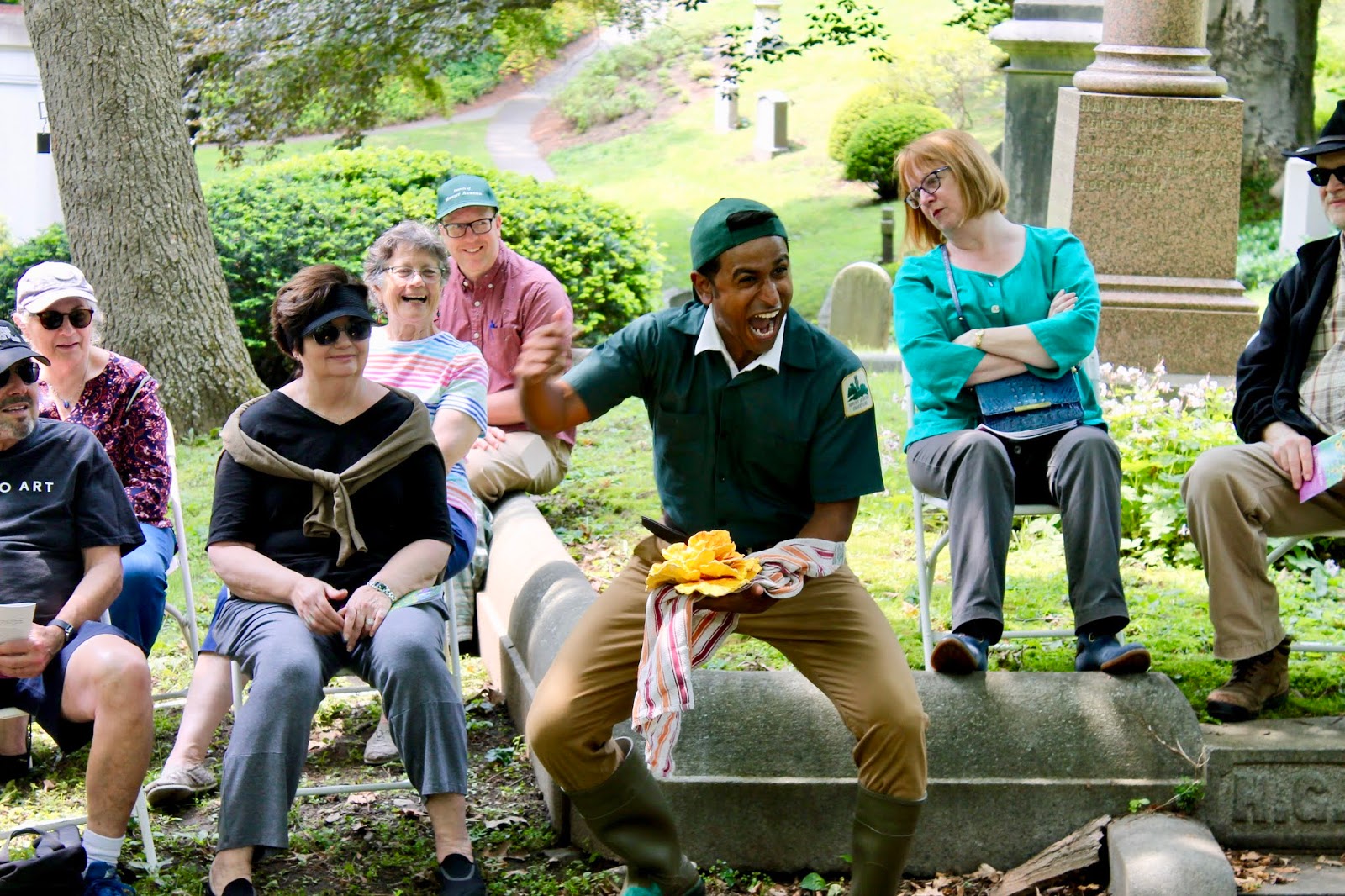
Jacob Athyal showing fungal gold in Sworn to Secrecy at Mount Auburn Cemetery
So in Part 1, I talked about Productions and Audience. Now it's time for the finances.

For a profession where we're supposed to be interested in honest conversation and diving deep into human questions that can make audiences squirm, playwrights are remarkably uncomfortable talking about money. We're pretty chickenshit about it, actually. 

A century ago, playwrights chose to be represented by a trade association rather than a union. Which means that we own our own copyrights (unlike screenwriters, who are represented by a union), and we are generally self-employed. But that independence comes at a cost--we don't have guaranteed minimum weekly wages like Equity actors or screenwriters represented by the WGA. Instead we need to negotiate our contracts and wages. Indeed, the Dramatists Guild, as I understand it, is prohibited from publishing a recommended amount for commissions or royalties, but instead can only advise on industry norms. (The Guild is awesome. If you're a playwright, you should join.)

Which makes it all the more imperative for playwrights to share information, on their own, even informally, about how much they're making for royalties, commissions, etc. Without knowledge of the market, we're left in the dark when we negotiate contracts with producers and theaters. When it comes to negotiations, money is power.

By cloaking the economic realities of our field, we do a tremendous disservice to writers who are new to playwriting. They have no idea what to expect. I encourage anyone who has a passion for writing plays to give it a try, but if they want to make this a gig that takes up most or all of their time, they should know the financial realities of how much they might make, and not just when they have a big hit, as well as what it costs to be a playwright (travel, memberships, tickets, etc.)

So, here is my little bit of financial data. I would worry that it could feel like bragging, but surely hauling in a whopping $11,000 annual net income isn't a sign of grand success for a grown adult who's been at this for 30 years. At the same time, I'm incredibly grateful for the money I've earned and that I can contribute at least something meaningful to my family. (And we do have this barn project that's going to take at least $50K in fixup costs to complete...)

And yes, we write because we love to create plays. No one gets into theatre for the money. But theatre is a business, and just like actors and designers and directors and administrators, playwrights need to buy groceries and diapers and pay rent. Let's do this with as much openness and information as possible.


Lisa Tucker and Ed Hoopman in Cerulean Blue at Mount Auburn Cemetery
Patrick's writing $$ for 2019

Gross Income:  $19,511    
published plays, performance royalties and advance:  $980
play production royalties:  $3,364   (for unpublished work--more than $2,500 was from Cato & Dolly)
film projects:  $0  
play commissions:  $10,750   (Mount Auburn artist-in-residence stipend)
teaching/coaching: $1,362   
my novels:  $215
Prizes/fellowships: $0     
Plays in Place: $2,000

misc. (essays, panels, editing, other): $840

Expenses:  about $7,500  (includes mileage expenses)  
This includes $740 in theatre tickets, $250 in research materials, and $1,300 in travel.

Net Income:  $11,761  (before taxes)

Past years:
2018:  Gross Income: $23,192  Expenses: $14,227  net:  $8,965

2017:  Gross Income: $31,343   Expenses:  $9,715  net:  $21,628
2016:  Gross Income:  $25,857  Expenses: $11,472  net:  $14,385
2015:  Gross income: $8,662  Expenses: $4,979  net:  $3,682
2014:  Gross income:  $7,974  Expenses $5,580  net:  $2,494
2013:  Gross income:   $7,767  Expenses:  5,758  net:  $2,029
2012:  Gross Income:  $3,844  Expenses:  $2,808  net:  $1,063
2011:  Gross Income:   $2,638   Expenses:  $4,665  net:  $-2,027


For 2020, my goal is to get my net income to be at least $12,000. I don't have quite enough productions and commissions lined up for that to happen yet, but I sure am working on it. I'll definitely need to continue to reduce my expenses in order to reach my goals.


Plays in Place projects will count for a big part of my income in 2020. The Plays in Place 2020 budget was close to $100,000 (more if you count my artist-in-residence stipend), and I think we can possibly stay steady for 2020 (almost all of that money goes to artist salaries). 


Coming Next: Writing by the Numbers 2019: Time


I want to develop new plays at this barn in Northampton, MA, but I need to earn some fixup money first.


Friday, December 27, 2019

Writing by the Numbers 2019: Audience and Output (and Inputs)

Chore Monkeys was published by Stage Rights in 2019
It's time for my annual summary of writing/work stats. This exercise is useful for me, personally, because it builds some accountability into a work life that doesn't have much overall structure or supervision. I also hope it's helpful for other writers by providing a glimpse into how one writer's life operates. We often either don't track what's going on, or else we keep stats as closely held secrets, because we either don't want to look like failures or else appear to be bragging. However, if we share the data widely, we all have a better sense of what's possible, or else feel less bad about how we ourselves are doing. And more data allows us to make informed choices and become better negotiators.

This year, I'm splitting my normal post into three parts, because one comprehensive data dump is too damn long. Today, I'll focus on Audience/Output/Inputs, and then over the next week, I'll write about money and time.

Theresa Nguyen The Nature Plays (Sworn to Secrecy) at Mount Auburn Cemetery
My writing/life stats for 2019 (part 1):  

Performances/Audience.
Number of Productions/Readings46 (43 productions, 3 readings) 

These were of 28 different plays, including 5 full-length scripts, and I'm counting The Nature Plays and The America Plays as full-length works, even though each is made of 5 separate short plays. This means I had 3 productions of full-length plays, all in Massachusetts. The one-acts and shorts were performed all over the place, including in Canada, Mexico, and 21 US states.

Number of Performances:  310.  This includes published plays. I shattered my old record of 259 from last year, thanks to Cato and Dolly running for 162 performances.

Previous Five Years productions and performances:

2018:  42 productions and readings.  259 performances.
2017:  48 total.  227 performances.
2016:  40 total. 106 performances.
2015:  49 total. 151 performances.
2014:  44 total. 123 performances.


Estimated Audience for 2019:  12,077 total

Previous Five Years audiences:
2018:  11,424
2017:  13,092
2016:  6,000
2015:  11,578
2014:  13,411

For published plays I estimate low--40 people/performance. I don't track plays used by students in competition, so the actual number is higher. Companies don't always give me the audience report, so I estimate the best I can.

I'm glad to see growth from last year, though it's not my best ever. My goal was 10,000, and I'm happy to have surpassed my goal.

It's worth noting that these audience numbers come from a LOT of small productions, plus some nice festivals, and three productions that I produced myself. Almost all these numbers are for short plays and one-acts. So when people ask, "why bother writing short plays?" I answer: because they reach audiences.

Reaching audiences is my most important goal and task, more than making money or getting famous--I want my work to engage with audiences. One of the best things about Plays in Place productions, especially Cato & Dolly, is that we don't just reach the usual theatre-going crowd--Cato & Dolly played to more than 4,000 people this year who randomly wandered into the Old State House off of the Freedom Trail. And they were highly engaged by the show.

Some perspective: being cautious of comparisons

It's all too human, especially for a numbers person, to want to compare how I'm doing to other writers out there. Since so few people share those numbers, it's a little hard to know. There's no doubt that high profile playwrights see much larger audiences (and make a lot more money). Lauren Gunderson gets many, many, many times more audience than I do, because she's getting regional productions all over the place. Don Zolidis is king of the educational theatre market right now, and he can see 1,000 productions at schools in a SINGLE YEAR. It's hard to even imagine how many people see Lin Manuel Miranda's work in any single week.

On the other hand, a fringe company in Boston might produce 3-4 shows and not see more than a couple thousand audience members for the whole season. And I've had years where I was lucky if a few hundred people saw my work in an entire year.

So, where do I stand, objectively, in the greater theatrical ecosystem? Hard to say. What matters is whether I'm reaching my own goals, and if I'm not, what can I do to improve next year.

Sarah Newhouse, Ken Baltin, Amanda Collins, and Robert Najarian in The America Plays (All the Broken Pieces)
at Mount Auburn Cemetery

Books sold:  35   Last year I sold 77, but I'd just released  The Secret of Spirit Lake.

Previous Five Years of book sales:
2018:  77
2017:  40+
2016:  60+
2015:  350+
2014:  78

Obviously the difference between the number of people who see my plays in a given year (more than 10,000) and the number who buy my books is pretty extreme. Part of this is because I don't spend much time marketing the books (some of which have been out for a while). Part of why I don't spend much time marketing the books is that I haven't figured out a way to do it successfully--when I do make the effort, it takes and time and money, but results in very few sales.

My sense is that part of this is because my books are not very genre-specific. And part of it is because of the huge glut of books in the marketplace right now, between traditional publishing houses, small presses, and self-published books. When Tornado Siren was first published, it got some traction, even though it was with a small press. And when I put out the ebook for it, it consistently picked up maybe a dozen ebook sales every month. The long-tail effect. But since then, because of the volume of competition, the long tail effect might still exist, but it has very little practical impact.


I'm still looking to find more readers for The Secret of Spirit Lake.

Submissions:

Total:   64 (down from 180 last year)
queries for plays:  2
play scripts submitted:  62 (Last year I sent 162)

I'd hoped to send out 170 scripts but didn't even come close. I'm always grateful that the Binge List for helps me have two months where I'm super focused on submissions, though I was deep in production during the fall Binge, so I submitted very few scripts.  Since 2013, I've been working on at least 1 commissioned piece every season, which takes up time and also alleviates some of the pressure to get super high submission numbers. 


Stephen Sampson and Marge Dunn in Cato & Dolly at Boston's Old State House
Writing output:

  • Researched and wrote three new one-act site-specific plays for Mount Auburn Cemetery (all of which Plays in Place produced this year). Though they were short plays, they were research-heavy, so it took a long time to complete them.
  • Wrote two new Christmas short plays. Looking forward to sending them out in 2020
  • Wrote a handful of new one-minute plays, one of which will premiere in the Boston One-Minute Play Festival next week.
  • Did some rewriting of my full-length play Flight, for a reading we had in NYC this summer.
  • Wrote a lot in my journal.
Inputs:
Plays watched:  39 (saw 54 in 2018)
Movies/TV series watched:  30 (57 in 2018)
Plays read: 23   (17 in 2018)
Books read:  19 (18 in 2018)

My numbers for play attendance were down a lot this year, but that's mostly because I was in production pretty solidly from April through mid October. My goal remains to read a lot more plays than I do, but a big chunk of my reading time is spent on dense history books for various projects. Someday I will reach my goal of reading at least one play a week. Being on selection panels for workshops and competitions does help me read more.


Blood on the Snow will return to the Old State House in October 2020

What I Expect in 2020:

I expect a BIG dip for audience in 2020, because I've been sending fewer submissions. I have some big productions lined up for 2020, Mox Nox and Blood on the Snow, plus Moonlight Abolitionists at Mount Auburn Cemetery,  but those are likely to account for maybe 3,000 attendees. I'd need some good luck to reach my goal of 10,000.

In terms of submissions, I will focus primarily on landing more gigs for Plays in Place. However, I now have a couple unproduced short plays and a bunch of shorts that I premiered at Mount Auburn Cemetery, some of which could be produced somewhere else. Which means I will have an easier time finding suitable opps, if I have the time to send them. I'd like to reach 100 submissions for next year. But again, I currently am in conversation with more than a dozen museums about possibly hiring me and Plays in Place to create work for their sites. Not all of those will pan out, and the ones that do often take a few years to come to completion, but the impact is large for me and my ability to reach audiences.

Not sure what's on tap for 2020, in terms of writing projects. I need to rewrite one of the Mount Auburn plays, Moonlight Abolitionists, plus some of my other full-lengths need work and there might be at least one new Plays in Place project. I'm a lot less interested in writing on spec than I used to be, but I have a play or two kicking around that might find their way out.


Coming next:  Writing by the Numbers 2019: Money