
Showing posts with label Boston Theatre Marathon. Show all posts
Showing posts with label Boston Theatre Marathon. Show all posts
Thursday, May 12, 2011
guest blogging at BPT
I'm the guest blogger over at the Playwrights' Perspective blog for the Boston Playwrights Theatre today, talking about how much I love the Boston Theater Marathon. Check it out.

Monday, March 28, 2011
Escape to Wonderland in Boston Theater Marathon
I got some good news last week: my play, Escape to Wonderland, will be in the next Boston Theater Marathon. (May 22, at the Calderwood Pavilion Theatre.)
The Boston Theater Marathon is one of favorite theatrical events every year (whether I'm in it or not, though I've been pretty lucky so far--this will be my eighth time in it): 50 new ten-minute plays, by 50 New England writers, produced by 50 different area theatre companies. All in one day. It's a tremendous smorgasbord of Boston theatre.
I won't find out which company will be producing the script for another month yet, but I'm dying to find out. I've made some great relationships with theatres and artists from being paired up at the Marathon.
This play was written as part of Mill 6's T Plays series last year, and had some tremendously good performances (our local NPR station did a fun story on the creation of it). I got to see it again this winter in DC, in the Madcap Players' Winter Carnival. One of the great things about being a playwright is getting to see multiple productions of the same play.
Here's a photo by Isaac Liu of Keva Colbert as Cassie and Niaya L. Little as Jackie in the Madcap version. (Directed by Gary Raymond Fry, Jr.)

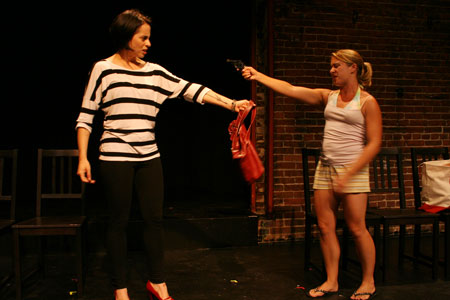
And here's one from the T Plays version, with Jen O'Connor and Ally Tully (directed by John O'Brien and Barlow Adamson).

The Boston Theater Marathon is one of favorite theatrical events every year (whether I'm in it or not, though I've been pretty lucky so far--this will be my eighth time in it): 50 new ten-minute plays, by 50 New England writers, produced by 50 different area theatre companies. All in one day. It's a tremendous smorgasbord of Boston theatre.
I won't find out which company will be producing the script for another month yet, but I'm dying to find out. I've made some great relationships with theatres and artists from being paired up at the Marathon.
This play was written as part of Mill 6's T Plays series last year, and had some tremendously good performances (our local NPR station did a fun story on the creation of it). I got to see it again this winter in DC, in the Madcap Players' Winter Carnival. One of the great things about being a playwright is getting to see multiple productions of the same play.
Here's a photo by Isaac Liu of Keva Colbert as Cassie and Niaya L. Little as Jackie in the Madcap version. (Directed by Gary Raymond Fry, Jr.)

And here's one from the T Plays version, with Jen O'Connor and Ally Tully (directed by John O'Brien and Barlow Adamson).

Thursday, May 20, 2010
Boston Theatre Marathon this Sunday

My ten-minute play, Confirmed Sighting, will be in the Boston Theatre Marathon this Sunday at the Calderwood Pavilion Theatre at the BCA. My show is at 7pm, produced by the Fort Point Theatre Channel, directed by Christie Gibson, starring two of my friends and fabulous actresses, Kippy Goldfarb and Maureen Keiller. The event runs from Noon until 10pm and is one of my favorite theatrical events of the year. All the proceeds of the day benefit the Theatre Community Benevolent Fund.
(Oh, and don't miss a reading of the fabulous play, The Live Dress, by my fellow Huntington Playwriting Fellow, Martha Kaufman, on Saturday, at 1pm. You won't be sorry.)
Thursday, June 4, 2009
An Open Challenge to Playwrights Writing for the Boston Theatre Marathon
I'm a big fan of the Boston Theatre Marathon, and I've been lucky enough to have had six plays chosen to be included over the past eight years or so. It's one of the best ways to a sampling of the best of Boston's theatre scene, all in one day. 50 plays by 50 writers produced by 50 different theatre companies. It's a great way to spend a day. This year I saw 48 out of 50.
This year a variety of strong plays played on the big Wimberly Theatre stage at the Boston Center for the Arts. There's always a mix of really good plays and stinkers, but it seemed there were less stinkers than usual to me. So that's good. And the performances were strong throughout the day.
A couple years ago, the Marathon moved from two small spaces (each less than 100 seats) at the Boston Playwrights Theatre, to the Wimberly. The Wimberly is a big stage--67' wide and 35' deep (the house seats 372). And that's where the Marathon bumps into problems. Most ten-minute plays are written to be performed in intimate spaces. Playwrights know that most short-play festivals are done in tiny little theatres, with almost no resources, so we write plays that can be done in shoeboxes with coffee can lights.
At the Marathon, there are still very limited resources, because the large number of plays by so many different companies requires very fast scene changes, almost no set, simple lights and sound (though they've got a great sound system--which theatres in the Marathon are under-utilizing). And also, the time between announcement of the plays and the actual production is currently too short. All these things cut into the ultimate production, and most can't be helped.
However, the playwrights do have control over the types of work that they're creating and the way it can inhabit the space. We're still submitting plays that can be ideally produced in a 10'x10' space. We're missing out on a unusual opportunity to play with our stories on a much bigger stage than usual. I'm not saying that every play in the marathon should be composed of cross-stage chase scenes, (archery, anyone?) but it wouldn't hurt to see a couple.
I remember one time the Marathon, at the Wimberly, the first play of the day started with three rock climbers hanging from ropes suspended from the fly system. As soon as I saw it, I thought, "Wow, we never could have done this play at BPT." Or even in most other theatres. It was amazing.
This year, very few plays fully inhabited the space or made good use of sound and color on the stage (mine included--mine was originally written to be done in a tiny little space at the Factory Theatre, and takes place on the T). So often, we got a few people sitting or standing around talking. Very little action and movement. Little color. One big exception was in the final hour, Laying the Smack Down in Cambridge by Jonathan Busch (directed by Brett Marks, produced by Lyric Stage), which was able (improbably) to mix poetry and professional wrestling.
Anyway, the challenge I'd like to issue to my fellow New England playwrights is this: let's try writing some ten-minute plays that make full use of the Wimberly's breadth and depth. Let's use the fact that it's has actual wing space and a kick-ass sound system. Let's write plays where people move around the stage, across the stage, and actually do stuff. Let's risk writing plays that can't possibly be produced in on a 20'x10' space, but will jolt the audience awake at the Marathon with a sudden rush of lively energy. (Of course, they still have to be brilliant enough to get past the judges.)
If we do it, and it gets a habit, audiences will thank us, we'll learn a lot about theatre itself, and people will be lined up for seats the way they used to when the Marathon was at BPT.
This year a variety of strong plays played on the big Wimberly Theatre stage at the Boston Center for the Arts. There's always a mix of really good plays and stinkers, but it seemed there were less stinkers than usual to me. So that's good. And the performances were strong throughout the day.
A couple years ago, the Marathon moved from two small spaces (each less than 100 seats) at the Boston Playwrights Theatre, to the Wimberly. The Wimberly is a big stage--67' wide and 35' deep (the house seats 372). And that's where the Marathon bumps into problems. Most ten-minute plays are written to be performed in intimate spaces. Playwrights know that most short-play festivals are done in tiny little theatres, with almost no resources, so we write plays that can be done in shoeboxes with coffee can lights.
At the Marathon, there are still very limited resources, because the large number of plays by so many different companies requires very fast scene changes, almost no set, simple lights and sound (though they've got a great sound system--which theatres in the Marathon are under-utilizing). And also, the time between announcement of the plays and the actual production is currently too short. All these things cut into the ultimate production, and most can't be helped.
However, the playwrights do have control over the types of work that they're creating and the way it can inhabit the space. We're still submitting plays that can be ideally produced in a 10'x10' space. We're missing out on a unusual opportunity to play with our stories on a much bigger stage than usual. I'm not saying that every play in the marathon should be composed of cross-stage chase scenes, (archery, anyone?) but it wouldn't hurt to see a couple.
I remember one time the Marathon, at the Wimberly, the first play of the day started with three rock climbers hanging from ropes suspended from the fly system. As soon as I saw it, I thought, "Wow, we never could have done this play at BPT." Or even in most other theatres. It was amazing.
This year, very few plays fully inhabited the space or made good use of sound and color on the stage (mine included--mine was originally written to be done in a tiny little space at the Factory Theatre, and takes place on the T). So often, we got a few people sitting or standing around talking. Very little action and movement. Little color. One big exception was in the final hour, Laying the Smack Down in Cambridge by Jonathan Busch (directed by Brett Marks, produced by Lyric Stage), which was able (improbably) to mix poetry and professional wrestling.
Anyway, the challenge I'd like to issue to my fellow New England playwrights is this: let's try writing some ten-minute plays that make full use of the Wimberly's breadth and depth. Let's use the fact that it's has actual wing space and a kick-ass sound system. Let's write plays where people move around the stage, across the stage, and actually do stuff. Let's risk writing plays that can't possibly be produced in on a 20'x10' space, but will jolt the audience awake at the Marathon with a sudden rush of lively energy. (Of course, they still have to be brilliant enough to get past the judges.)
If we do it, and it gets a habit, audiences will thank us, we'll learn a lot about theatre itself, and people will be lined up for seats the way they used to when the Marathon was at BPT.
Thursday, May 21, 2009
Boston Theatre Marathon Roundup
I had a great time at the Boston Theatre Marathon on Sunday at the Calderwood Pavilion Theatre in Boston's South End. I think I set my own record for number of plays watched--48 out of 50 ten-minute plays.
My play, Recognition, went very well. I had two young actresses, Ashley Gramolini and Sarah Barton, who have a lot of talent and worked hard, as well as terrific director in Nora Hussey. I was a little worried about having a serious drama follow Rick Park's super funny Please Report Any Suspicious Activity, but the audience seemed to handle the transition well, and they paid rapt attention during our piece.
Overall, the day felt comfortable. Not many pieces that I detested, and a lot of plays that I liked. When you watch so many, they do tend to blend together after a while. (Dave Schrag put together a list of common topics on his blog.)
I did have a few favorites for the day:
As always, I'm grateful to Kate Snodgrass and all the folks at Boston Playwrights Theatre and at the BCA, and all the volunteers, for putting on a great event. Can't wait until next year.
My play, Recognition, went very well. I had two young actresses, Ashley Gramolini and Sarah Barton, who have a lot of talent and worked hard, as well as terrific director in Nora Hussey. I was a little worried about having a serious drama follow Rick Park's super funny Please Report Any Suspicious Activity, but the audience seemed to handle the transition well, and they paid rapt attention during our piece.
Overall, the day felt comfortable. Not many pieces that I detested, and a lot of plays that I liked. When you watch so many, they do tend to blend together after a while. (Dave Schrag put together a list of common topics on his blog.)
I did have a few favorites for the day:
- Safely Assumed by Andrea Fleck Clardy was both serious and clever in its look at racial assumptions. I look forward to seeing more plays by her.
- Ken Urban's White People came off especially well, I thought, with two strangers connecting on the subways.
- Bill Donnelly's Sugar Glider still had me thinking and talking about it on Tuesday night. Kevin LaVelle, whomI've worked with a lot, was the perfect match for the script.
- I'm always happy to see Rough & Tumble, and their When No One Comes Calling brought a bit of color to a stage that can feel a little drab over the course of the day (more about that in another blog entry soon).
- Gary Garrison's play The Sweep covered a lot of ground, but seemed to pull it off (and got two strong performances from Rick Park and Michael Steven Costello).
- Laying the Smack Down in Cambridge by Jonathan Busch was probably my favorite of the evening combining a bad poet, bad poetry, and professional wrestling.
As always, I'm grateful to Kate Snodgrass and all the folks at Boston Playwrights Theatre and at the BCA, and all the volunteers, for putting on a great event. Can't wait until next year.
Sunday, May 17, 2009
Boston Theatre Marathon today
The Boston Theatre Marathon runs all day today from Noon to 10 p.m. at the Calderwood Pavilion Theatre at the Boston Center for the Arts. For one ticket, you can see 50 different plays by 50 different New England writers, produced by 50 different companies (and the whole thing benefits charity). A test of your endurance, but incredibly fun. My show, Recognition, will be on stage at 2 p.m. (and follows a very, very, very funny play by Rick Park). I've got a terrific cast from the Wellesley Summer Theatre, directed by Nora Hussey. Should be a very good show. Can't wait.
Friday, April 17, 2009
Recognition in 2009 Boston Theatre Marathon
Some good news (which has been known for a while, but I've been too swamped to blog lately): my short play, Recognition, will be included in this year's Boston Theatre Marathon, on Sunday, May 17th, at the BCA/Wimberly Theatre. The Wellesley Summer Theatre will produce my play, with Nora Hussey directing. They're an immensely talented group, a perfect match for my play, really, and I'm excited to have the chance to work with Nora, after seeing her work a number of times.
The BTM is one my favorite theatrical events--50 ten-minute plays, by 50 different writers, produced by 50 different New England theatres, all in the space of 10 hours. There is no better way to get a sampling of the Boston theatre community. I've been very fortunate over the years--this will be the sixth time one of my plays has been part of the Marathon.
Recognition was originally created as part of the T plays last fall, with the Mill 6 Theatre Collaborative--a group of plays created on and about the T (Boston's subway system). Three of those scripts will be included in this year's Marathon.
I should find out what time slot my play will have in a few weeks.
The BTM is one my favorite theatrical events--50 ten-minute plays, by 50 different writers, produced by 50 different New England theatres, all in the space of 10 hours. There is no better way to get a sampling of the Boston theatre community. I've been very fortunate over the years--this will be the sixth time one of my plays has been part of the Marathon.
Recognition was originally created as part of the T plays last fall, with the Mill 6 Theatre Collaborative--a group of plays created on and about the T (Boston's subway system). Three of those scripts will be included in this year's Marathon.
I should find out what time slot my play will have in a few weeks.
Monday, May 21, 2007
Boston Theatre Marathon IX (and disturbing omissions)
I attended one of my favorite theatrical events on Sunday, the annual Boston Theatre Marathon. The Marathon features 50 ten-minute plays by 50 different New England writers, each produced by a different New England theatre company. Running from noon until 10pm, with five plays every hour, it's an event with a great amount of energy, sparked by fifty casts performing for a warm crowd.
One of BTM's strengths is that theatres of all different sizes participate. So the Huntington and the ART both produce plays (the ART does a Robert Brustein play every year) alongside the Devanaughn Theatre and Hovey Players. With more than 150 local actors involved, it's an unparalleled chance to see Boston's theatre community in action.
I've been lucky to have had four plays in past Marathons, but I didn't have on in this year's festival. (So the comments below should be seen with that in mind, I suppose.)
I got to my seat right at noon as the lights were going down, and I lasted all the way until 9pm. It's a lot easier to last the whole day now that the venue has been shifted to the Stanford Calderwood Pavillion Wimberly Theatre, a beautiful new theatre built for the Huntington, that seats 360 in very comfy seats. The BTM used to be at Boston Playwrights theatre, which is small, and has seats that cause partial paralysis after three or four hours.
Still, I couldn't make it to the final hour. I was just too tired, and all the plays were starting to blur together for me, and weak scripts that might not have seemed so bad in hour 3 or 4, now felt excrutiating in my exhausted state. No sense hating plays that don't deserve it.
I'll spare you my rundown of the entire festival. The first hour was particularly strong, and I really enjoyed Gary Garrison's play, Storm on Storm (with my weather background from Tornado Siren, it was right up my alley). Bob Murphy and Kelly Lawman were delightful in it. Ranch on the Run wasn't a perfect play, but at least it offered a bit of whimsy and theatricality, with a short tale about a runaway house. My Rhombus friends Kirsten Greenidge and Leslie Dillen both were well-served by their productions of their plays.
One play that caught my attention was Ritz Rendezvous by Gregory D'Angelo, produced by the Stoneham Theatre. The chemistry of the actors, Christopher James Webb and Jessica Webb really drew me in and and had me laughing hard. Great timing.
There were a few duds here and there, but no total train wrecks.
I was disappointed in the general lack of imaginativeness and theatricality of the staging of plays (though it was great to see a kayak on stage). Rough & Tumble did their part, along with Ranch on the Run (mentioned above), but there were an awfully lot of domestic dramas and comedies. I found myself pining desperately for something fantastical, something that at least offered bright colors and something interesting to look at. This was the first year I can remember with no musicals.
I find it very disturbing that in the 44 plays that I watched, there were no strong political plays (with the exception of Monica Raymond's very gentle, Hijab). There was one tiny mention of the Iraq war in The Polish Pictures by Monica Bauer, and a few references to George Bush in The Red and The Blue, but all minor. There was nothing in the nine hours of plays that I watched that would make you realize that we're at war and have been at war for more than four years. Nothing to make you realize that the current presidential administration is drowning in its own incompetence. Nothing that talks about the current state of race relations, about class in America, about the current rise of corporate power, about global warming, AIDs (in Africa or anywhere else), about the history of anything. Nothing about a struggle that's larger than the scope of own heads, or our own families. (Einstein + The Angels by Laura Harrington did offer some sort of post-apocalyptic vision, but the nature of the apocalypse itself was vague).
I'm not saying that I want diatribe after diatribe, and I understand that theatre works in the interpersonal relationships between human beings on stage. However, nine hours without any modern political shout or protest, or hell, even a slight clearing of a playwright's artistic throat is chilling. Theatre has the power to speak to the human AND human political condition, the state of our world. If theatre fails to use that power, it will weaken and become more irrelevant.
I hope that in next year's Marathon, we'll hear some voices who have something to say about the state of the world in which we live.
One of BTM's strengths is that theatres of all different sizes participate. So the Huntington and the ART both produce plays (the ART does a Robert Brustein play every year) alongside the Devanaughn Theatre and Hovey Players. With more than 150 local actors involved, it's an unparalleled chance to see Boston's theatre community in action.
I've been lucky to have had four plays in past Marathons, but I didn't have on in this year's festival. (So the comments below should be seen with that in mind, I suppose.)
I got to my seat right at noon as the lights were going down, and I lasted all the way until 9pm. It's a lot easier to last the whole day now that the venue has been shifted to the Stanford Calderwood Pavillion Wimberly Theatre, a beautiful new theatre built for the Huntington, that seats 360 in very comfy seats. The BTM used to be at Boston Playwrights theatre, which is small, and has seats that cause partial paralysis after three or four hours.
Still, I couldn't make it to the final hour. I was just too tired, and all the plays were starting to blur together for me, and weak scripts that might not have seemed so bad in hour 3 or 4, now felt excrutiating in my exhausted state. No sense hating plays that don't deserve it.
I'll spare you my rundown of the entire festival. The first hour was particularly strong, and I really enjoyed Gary Garrison's play, Storm on Storm (with my weather background from Tornado Siren, it was right up my alley). Bob Murphy and Kelly Lawman were delightful in it. Ranch on the Run wasn't a perfect play, but at least it offered a bit of whimsy and theatricality, with a short tale about a runaway house. My Rhombus friends Kirsten Greenidge and Leslie Dillen both were well-served by their productions of their plays.
One play that caught my attention was Ritz Rendezvous by Gregory D'Angelo, produced by the Stoneham Theatre. The chemistry of the actors, Christopher James Webb and Jessica Webb really drew me in and and had me laughing hard. Great timing.
There were a few duds here and there, but no total train wrecks.
I was disappointed in the general lack of imaginativeness and theatricality of the staging of plays (though it was great to see a kayak on stage). Rough & Tumble did their part, along with Ranch on the Run (mentioned above), but there were an awfully lot of domestic dramas and comedies. I found myself pining desperately for something fantastical, something that at least offered bright colors and something interesting to look at. This was the first year I can remember with no musicals.
I find it very disturbing that in the 44 plays that I watched, there were no strong political plays (with the exception of Monica Raymond's very gentle, Hijab). There was one tiny mention of the Iraq war in The Polish Pictures by Monica Bauer, and a few references to George Bush in The Red and The Blue, but all minor. There was nothing in the nine hours of plays that I watched that would make you realize that we're at war and have been at war for more than four years. Nothing to make you realize that the current presidential administration is drowning in its own incompetence. Nothing that talks about the current state of race relations, about class in America, about the current rise of corporate power, about global warming, AIDs (in Africa or anywhere else), about the history of anything. Nothing about a struggle that's larger than the scope of own heads, or our own families. (Einstein + The Angels by Laura Harrington did offer some sort of post-apocalyptic vision, but the nature of the apocalypse itself was vague).
I'm not saying that I want diatribe after diatribe, and I understand that theatre works in the interpersonal relationships between human beings on stage. However, nine hours without any modern political shout or protest, or hell, even a slight clearing of a playwright's artistic throat is chilling. Theatre has the power to speak to the human AND human political condition, the state of our world. If theatre fails to use that power, it will weaken and become more irrelevant.
I hope that in next year's Marathon, we'll hear some voices who have something to say about the state of the world in which we live.
Subscribe to:
Posts (Atom)