My short play, Curse the Darkness, is one of the winners in the 12th annual Chameleon Theatre Circle Contest. The winning plays will receive staged readings on Saturday, September 10th, at their theatre at the Burnsville Performing Arts Center (it's near Minneapolis/St. Paul). I'll post the exact time once they have it, in case any of you are in the area. The readings are free and should be a lot of fun.
You can read the entire script by clicking here.

Monday, August 8, 2011

Saturday, August 6, 2011
reaching the finish line (sort of)
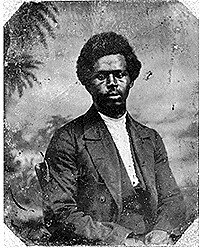
I just finished the first draft of my new Civil War novel about Robert Smalls (pictured above). I started this project as a screenplay eight or nine years ago, but ended up putting it aside for a long time. I did a ton of research, but couldn't find a producer who'd take a chance on a Civil War costume war drama at that time.
But I never stopped thinking about Robert Smalls or the project and decided that someday I wanted to write his story as a novel. Early in 2010, I started renewing my research, and Tracy and I even took a quick trip to Charleston and Beaufort, South Carolina, where most of the novel takes place.
People often ask me how long it takes to write a book. The answer is that it depends on what you mean. It took me fourteen months to write this current draft, which currently runs about 126,000 words or about 400 pages. I think it'll take another year to revise it sufficiently so I can show it to people in the publishing industry. This draft took a while to write, because I was doing research every step of the way, even though I'd done a lot of my initial reading back in 2003, and had been able to lay out a pretty decent outline for the story at that time. (I was able to use quite a bit of my old outline, thought it shifted a lot.)
For me, novels are such big projects that there are many different finish lines. The one I crossed today is an important one. Now I have a structure and story in place. The bones of the book are all there. I've done most of the important research, though there's still lots more to fill in (but now I'll have a better sense of what I'm missing). But my first drafts are rough--practically unreadable, I'm sure, to anyone but me. Now it's all about clarifying the characters and working on the language. I write a book like a painter might make a painting, first with thin pencil lines, and then gradually adding more and more layers of color, until the whole image finally comes together. I've still got a long way to go.
But it sure feels good to have reached this milestone. Now I'll have to give myself a little space before I even look at the manuscript again. I won't even look at it for about a month, until the kids are back at school, and I've had a chance to get a little distance. I'm sure I'll be surprised (and sometimes horrified) by what I read. I tend not to reread the manuscript as it progresses, so there are parts of this book that I haven't looked at for more than a year. In September, it'll be my job to load the whole thing back into my mind and start figuring out how to make it good.
But for now, I plan to enjoy the warm glow that comes from having finished a solid first draft.
Wednesday, August 3, 2011
what I'm writing: early morning report from the trenches
Summer vacation is fun, of course, but it's also the hardest season to find time time to write. In July, Noah had summer school and camp, so I actually had more time to write than during the year. But now we've entered into the long hot stretch of August and early September. I've been hard at work on a new novel for about a year now, about the Civil War hero, Robert Smalls. It's been great fun and I'm getting close to finishing a very rough (practically unreadable to anyone but me, but that doesn't really matter, it's just getting the story and structure down that counts for me at this stage). It's a bit longer than I usually write--I'm at about 120,000 words, or somewhere around 400 pages. Just two more chapters to go.
This means that as of this week, my writing time has shifted to 5am. If I set my alarm for 5, I can be at work at my desk by 5:08am, and get in about 2 hours. (I used to get up early all the time to write when the kids were little, but I'm spoiled now that they're in school.) Luckily, I have an outline and most of the research is done, though thanks to the internet, there is no hour of the day when my attention might not be drawn by a little bit of last minute research (like the range of a 20 pound Parrot Rifle (1,900 yards) or a 9-inch Dahlgren). My goal is about 1,000 words a day, though closer to 1,500 would make me ecstatic. (Yesterday I wrote 600 words and was grateful. Today it was 1,400.)
With any luck, I'll finish this draft by the end of August, and then can get back to revisions of my new play, Flight, while this project settles for a month or two. (I figure it'll take me as much as a year to revise the novel to a point where it might be ready to be submitted.)
Monday, July 25, 2011
report from Carrboro: Best of 10x10 (is great) (thanks, audience)
I got to see performances of the Best of 10x10 on both Saturday and Sunday and am grateful that I could come here. (Thanks to ArtsCenter for travel and lodging!) They've put together what may be one of the best evenings of ten-minute plays I've seen. If you follow which writers get their work done in short play festivals, you wouldn't be surprised, because the writers included: Mike Folie, Mark Harvey Levine, Babs Linsday, Matt Casarino, Chris Lockheardt, and Doug Reed--all of whom have work that appears regularly across the country. (It's almost impossible to find a short play festival without a play by Mark Harvey in it.)
The plays tended to be comedies (Matt's play, Green Eggs and Mamet, made me weep with laughter), which made me a little nervous about my play, Ship of Fools, which is an odd drama drama/puzzle about two women stuck in a lifeboat, who entertain each other by pretending to be other people (spoiler: the boat sinks in the end). Sometimes an audience gets up so much momentum for laughing and having a good time, that they don't have patience for a short play which requires a bit of untangling during the short time it's on stage.
Both nights I saw the play, the audience was large--the venue holds 350, and it was sold out Saturday and close to sold out Sunday at 3pm. I repeat--they sold probably close to 300 tickets for a 3pm Sunday show of ten-minute plays.) They were definitely having a good time, thanks to good scripts and very strong performances. I was worried my play might get swept away.
But it didn't. (huge relief) For a couple reasons: First--strong performances. The two actresses Jillian Holmquist and Jenny Wales, completely committed to the play and the game they were playing, and gave us a sense of what they were doing, despite only having a bare stage with two chairs.
Also, the sound/music design and performance helped channel the audience momentum and shifted the mood. Nathan Logan, who designed the music/sound, also performed live on stage during the scene shifts throughout the entire performance--singing and playing electric guitar and keyboard. I love having live music on stage, and he really knew how to be an unobtrusive presence during the plays (he was onstage the whole time), and then could really play during the shifts to get the audience where it needed to go. For the lead in to Ship of Fools, he sang a haunting a cappella version of "Sailing" which was initially written and performed by the Sutherland Brothers in 1972--you can listen to it here--and made famous by Rod Stewart. It worked perfectly. (Nathan's version of it is still stuck in my head.)
The last factor was the audience itself. The ArtsCenter 10x10 audience was incredibly engaged. They were lively and there to have fun, but it was also clear that they loved being there (this wasn't attended out of obligation), they had a relationship with the theatre and the performers, and they wanted to pay attention. As a playwright, I go to productions for lots of reasons (for fun, to see scripts in production, see good performances, to be moved, tickled, etc.), and one of those reasons is to be with audiences. They vary as much, night-to-night, as performances. Maybe more. I think about audiences a lot--what makes them tick, how they will respond. As a playwright, maybe I'm a bit of a conniseur of audiences. I'm always looking for the right match between text, performance, and audience. That's where the magic of theatre really comes together.
Here at 10x10, they have a kick-ass audience, and it was a treat to be part of it for two nights.
After the show, I talked to several people who said they loved Ship of Fools, and especially that it was a play that made them work, and that it moved them emotionally. That's pretty much exactly what I wanted. Very nice.
Thanks to Jeri Lynn Schulke, artistic director, for putting the evening together, to Lyden Harris for starting the festival and keeping it going for so long, to both Lynden and Emily Ranii, for producing my plays at 10x10 in the past. They've really got a good thing going here. And thanks to my director, Jerry Davis, and the entire production team for putting together a great show.
Here's a (somewhat blurry, sorry) photo of the audience waiting for the Best of Ten by Ten to start (and there's Nathan getting ready to play guitar).

Thursday, July 21, 2011
Freeman rocks
I've been very much enjoying Matthew Freeman's blog lately, including this post on How to Quit Being a Playwright. The first point is my favorite, and the hardest part about doing it. It's actually easy to quit (in theory)--you just stop. And you don't need to tell anyone. You don't need to write a furious blog post, there's no paperwork to fill out, no HR person to notify. You don't get a farewell party. There's no one who recruited you into playwriting who is likely to be hurt that you're leaving. You'll be missed by some of your theatre friends, for a while, but not as much as you'd like.
I also very much like his recent post on Day Jobs and Staying an NYC playwright, too. (Which also connects to a nice essay on the same topic by Barbara Hammond.)
I also very much like his recent post on Day Jobs and Staying an NYC playwright, too. (Which also connects to a nice essay on the same topic by Barbara Hammond.)
Heading to North Carolina
This weekend, I'll be heading to the Raleigh-Durham area in North Carolina, to see my play Ship of Fools in the Best of Ten by Ten Festival at The ArtsCenter in Carrboro . These folks have produced a handful of my plays over the years, and I'm excited to finally have a chance to meet them and see their talents in action.
Any suggestions for good places to eat in Raleigh-Durham (or Carrboro) and/or good farmer's markets (or farms to visit)?
Any suggestions for good places to eat in Raleigh-Durham (or Carrboro) and/or good farmer's markets (or farms to visit)?
Thursday, July 7, 2011
Thoughts Not to Think. (Don't read this list.)
There are lots of rational reasons to be discouraged and depressed as a writer of plays and novels. There are 75-100 new MFA playwrights graduating every year, and nowhere near that many new slots for full-length plays on professional stages. It's harder than ever to find an agent for playwrights, because the money keeps shrinking. So many books are published every year that it's getting harder and harder for a new book to stand out. Because it's harder to make money in publishing, publishers are tending to bid on books with clear blockbuster appeal, and the midlist book (and author) is dying a not-so-gradual death.
Keeping your spirits up in the face of the business climate in our art forms is pretty tough. I'm a pretty up-beat guy, most of the time, but once I start looking at the climate outlined above, it's easy for other, completely unhelpful thoughts to creep in.
I'm sure you can think of a few more.
One of the aspects that I don't hear much about, in our conversations as writers, is how we manage to keep all this crap at bay and not be drowned by it. And it gets harder as we get older, as the new sheen of optimism towards attempting a writing career has worn away.
Sometimes I give in and indulge these lines of thought for a while. It's only human, I guess. It can help to get together with friends, with fellow writers, especially if there's good news to share. Mutual whining doesn't help. The main tactic that succeeds for me is actually sitting my ass in the chair writing. For a good solid chunk of time, more than one day at a time. String a few mornings together, and I can start to lose track of the other bullshit and remember that I like writing. A lot. The rest doesn't have to matter so much.
Keeping your spirits up in the face of the business climate in our art forms is pretty tough. I'm a pretty up-beat guy, most of the time, but once I start looking at the climate outlined above, it's easy for other, completely unhelpful thoughts to creep in.
Here are some thoughts that will not help you. Don’t think them. Seriously, don’t even read this list.
- I’m XX years old. I had my chance, it’s all downhill from here. I peaked in 19XX. Writing is a young person’s game
- My friend K. just got a book deal/production/residency. For $XXX,000. But that’s never going to happen to me. One deal was worth more than I’ve made in my entire career.
- When I come up with the ideas, they seem great. But when I finally get them on paper, they always seem to come up short. Maybe I just don’t have what it takes.
- I have some talent, but just not quite enough. I’ve given it my best shot.
- I’ve been at this for DD years. If it was going to happen, it would have already happened.
One of the aspects that I don't hear much about, in our conversations as writers, is how we manage to keep all this crap at bay and not be drowned by it. And it gets harder as we get older, as the new sheen of optimism towards attempting a writing career has worn away.
Sometimes I give in and indulge these lines of thought for a while. It's only human, I guess. It can help to get together with friends, with fellow writers, especially if there's good news to share. Mutual whining doesn't help. The main tactic that succeeds for me is actually sitting my ass in the chair writing. For a good solid chunk of time, more than one day at a time. String a few mornings together, and I can start to lose track of the other bullshit and remember that I like writing. A lot. The rest doesn't have to matter so much.
Subscribe to:
Posts (Atom)